Child Birth Registration in the Philippines 2026
Child birth registration in the Philippines is an important legal process that officially recognizes a newborn’s identity and records their birth with the government. Parents must register their baby’s birth to obtain an official Philippine Birth Certificate, which is needed for important documents and services, including passport applications, school enrollment, PhilHealth benefits, and other government transactions. In 2026, parents can register their child’s birth through the Local Civil Registry Office (LCRO) of the city or municipality where the baby was born.
The process generally requires submitting a Certificate of Live Birth and providing the necessary information about the child and parents. Once registered, the birth record is forwarded to the Philippine Statistics Authority (PSA) for official recording. Whether you are registering a newborn, checking birth registration requirements, or applying for a PSA birth certificate, this guide explains the complete process, required documents, registration deadlines, applicable fees, late birth registration, and how to obtain an official birth certificate in the Philippines.
Child Birth Registration — The Facts in 60 Seconds
| Question | Answer |
|---|---|
| What it is | Recording your child’s birth at the Local Civil Registry Office (LCRO) where the birth happened |
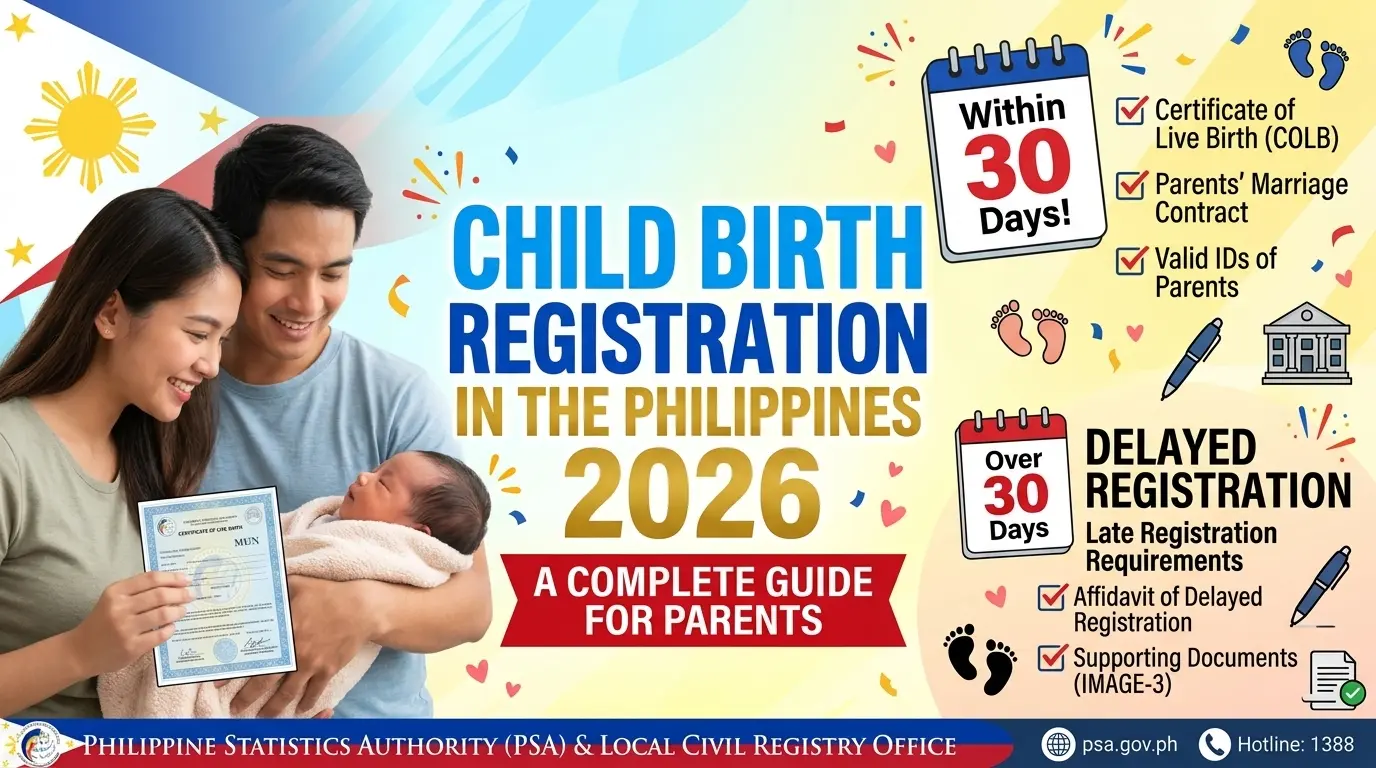
| Deadline | Within 30 days from the date of birth |
| Main law | Act No. 3753 (Civil Registry Law of 1930) |
| Main document | Certificate of Live Birth (Municipal Form No. 102), in four copies |
| Who registers | Parents first, then the attending doctor, nurse, or midwife |
| Cost of timely registration | Free — no registration fee |
| Late registration | After 30 days; needs an affidavit, a PSA Negative Certification, and supporting documents |
| PSA copy fee | ₱155 at a PSA outlet; ₱330 via PSA Serbilis delivery; ₱365 via PSAHelpline delivery |
| Official PSA website | https://psa.gov.ph/ |
What Is Child Birth Registration in the Philippines?
Child birth registration is the official recording of your child’s birth with the government. When a child is born, the facts of the birth — the child’s name, sex, date and place of birth, and the parents’ names — are written on a form called the Certificate of Live Birth (COLB). That form is filed at the Local Civil Registry Office (LCRO) of the city or municipality where the birth happened. The LCRO keeps the local record, and a copy goes to the Philippine Statistics Authority (PSA), which keeps the national record.
The system has two levels. The LCRO is the frontline office: it accepts the form, checks the details, and records the birth. The PSA is the central authority: it stores every birth record in the country and issues the official PSA birth certificate, which is the copy most offices ask for. When people say “PSA birth certificate,” they mean the copy printed on the PSA’s security paper, taken from that national record.
There is no single website where you register a birth online. Registration itself happens in person at the LCRO, because the form must be signed and the original documents must be shown. What you can do online is order a copy of the PSA birth certificate after the birth has been registered, through PSA Serbilis or PSAHelpline. Any website that promises to register a birth for you online for a fee is not an official channel — do not pay it.
Why Registering Your Child’s Birth Matters
A birth certificate is the first identity document your child will ever have. In the Philippines, it is the base document for almost everything that comes later. Schools require it for enrollment, from kindergarten through college. The Department of Foreign Affairs requires it for a passport application. PhilSys, the national ID system, uses it to confirm a child’s identity. Government programs, health insurance enrollment, and even a first bank account all start with the same question: “May we see the birth certificate?”
When a birth is never registered, the child has no official record of existing. That creates problems that grow with age. A child without a birth certificate may be turned away from school enrollment or enrolled only as a temporary student. As a teenager or adult, the person cannot get a passport, a driver’s license, or a national ID without first going through late registration — a longer process with more documents, affidavits, and waiting time. Fixing the problem at age 25 is far harder than fixing it in the first month of life, because the supporting documents from childhood may be gone and the process requires personal appearance before the civil registrar.
There is also a practical reason to register early: it costs nothing. Timely registration, done within 30 days, carries no registration fee. The only costs are the copies you choose to order later. Late registration always costs more — fees, notarization, and the time spent gathering supporting documents. So the cheapest and simplest time to register is in the first month.
Who Must Register the Birth — and Where
The law sets a clear order of who is responsible for registering a birth. First in line are the parents — the father or the mother of the child. If the parents cannot do it, the duty falls to the attending physician, nurse, or midwife who was present at the delivery. If none of them can do it, the person who took charge of the child at birth is responsible. In practice, when a child is born in a hospital, the hospital’s staff usually prepares the Certificate of Live Birth and files it with the LCRO on the parents’ behalf. When a child is born at home, the parents — or the midwife or hilot who attended the birth — must report it and file the form themselves.
Where you register matters as much as when. The birth must be registered at the LCRO of the city or municipality where the birth occurred, not where the parents live now. If your child was born in a hospital in Quezon City but you live in Cavite, the registration goes to the Quezon City LCRO. If you file at the wrong office, the LCRO will not accept it, and you will lose days going back and forth. Before you travel, confirm the exact LCRO: check the city or municipal hall’s directory, or call the office to confirm its hours and whether it accepts walk-ins for birth registration.
Bring valid IDs when you go to the LCRO. The person filing the registration — usually one of the parents — should carry a government-issued ID with a photograph. The LCRO will also ask for the parents’ details: full names, ages, occupations, nationalities, and civil status. If the parents are married, the LCRO may ask for the marriage certificate. If they are not married, the rules on the child’s surname are different, and the mother is the one who generally files. Under Republic Act No. 9255, an illegitimate child may use the father’s surname, but only if the father signs an Affidavit to Use the Surname of the Father (AUSF). Without that affidavit, the child uses the mother’s surname.
Timely Registration: Step-by-Step Within 30 Days
Timely registration means filing the Certificate of Live Birth within 30 days from the date of birth. Follow these steps in order, and keep a copy of everything you submit.
Step 1: The Certificate of Live Birth is prepared. In a hospital birth, the attending doctor, nurse, or midwife fills out the COLB — Municipal Form No. 102 — using the facts of the delivery. The form records the child’s full name, sex, date and hour of birth, place of birth, type of delivery (single, twin, and birth order if there are multiples), and the parents’ information. The form is made in four copies: one for the LCRO, one for the PSA, one for the parents, and one for the attending physician or midwife. Check every entry before anyone signs it. A wrong spelling or a wrong date on this form will follow your child onto every document after it, so read the form twice and correct mistakes on the spot.
Step 2: The parents sign the form. Both parents sign where required. If the child is illegitimate and the father is acknowledging the child, the father signs the acknowledgment portion and, if the child will use his surname, the Affidavit to Use the Surname of the Father. If the mother is the only parent filing, she signs as the informant. Do not leave any required signature blank — an unsigned form is returned, and the 30-day clock keeps running.
Step 3: Submit the form to the LCRO. Take all four copies to the LCRO of the city or municipality where the birth happened. The LCRO checks the form for completeness, stamps it, and records the birth in the local civil registry book. Timely registration is free — there is no registration fee for filing within 30 days. Some LGUs charge a small fee for certified copies, but the registration itself costs nothing.
Step 4: Get your copy and the registry number. After the LCRO records the birth, ask for a certified copy of the registered COLB and note the registry number. Keep this copy at home in a safe place. It is your proof that the birth was registered, and you will need it if the PSA record is ever questioned.
Step 5: Wait for the record to reach the PSA. The LCRO sends its records to the PSA, but this takes time. For a birth in Metro Manila, allow 2 to 4 months from the date the LCRO transmitted the record before ordering a PSA copy. For a provincial birth, allow at least 6 months. If you order a PSA birth certificate too early, the PSA will reply that no record is found — not because the registration failed, but because the record has not arrived yet. Wait out the full period before you order, or ask the LCRO for the transmittal date so you know when to count from.
Documents You Need for On-Time Registration
For a birth registered within 30 days, the checklist is short. Bring the following to the LCRO:
- The completed Certificate of Live Birth (Municipal Form No. 102) in four copies, signed by the parents and the attendant.
- Valid government-issued ID of the person filing — a passport, driver’s license, national ID, or any photo ID the LCRO accepts.
- The parents’ marriage certificate, if the parents are married. If the parents are not married, the mother’s ID is the key document, plus the father’s Affidavit to Use the Surname of the Father if the child will carry the father’s surname.
- Proof of the birth, if the LCRO asks for it — the hospital’s records, a medical certificate, or the attendant’s written statement for a home birth.
Some LCROs ask for additional items, such as a barangay clearance or a certificate of indigency if you are asking for a fee waiver on certified copies. Rules differ slightly from one city or municipality to another, so call the LCRO before your visit and ask for its exact checklist. A five-minute phone call can save you a wasted trip.
Late Registration: What Happens After 30 Days
A birth registered more than 30 days after it happened is called delayed registration, or late registration. It is still possible at any age — for an infant, a minor, or an adult — but the process is stricter, because the government must make sure the birth facts are real before it creates a permanent record. The rules were tightened under the PSA-DILG Revised Guidelines for Delayed Registration of Birth and PSA Memorandum Circular No. 2024-17, so expect more documents and more waiting than with timely registration.
The first step is to prove that no birth record exists yet. Get a PSA Negative Certification of Birth from the PSA. This document says the PSA has searched its national database and found no birth record for the person. You can request it at any PSA Civil Registry System (CRS) outlet — with an appointment — or through PSA Serbilis. Since 23 March 2026, all clients visiting PSA CRS outlets, including National ID holders, must have an appointment. The PSA’s public advisory says a Negative Certification is valid for six months from issuance, so do not get it too early: file the late registration while it is still valid.
Next, prepare the Affidavit of Delayed Registration. This is a sworn statement explaining the specific reason for the delay — for example, a home birth in a remote barangay, the parents’ lack of awareness of the 30-day rule, or financial hardship. Vague statements are often questioned, so write the real reason in plain words and have the affidavit notarized. For a minor child, the affidavit is executed by the parents or the legal guardian. For an adult, the person registers for themselves.
Then gather the supporting documents. The current rules require at least two public or private documents that independently prove the facts of the birth — the name of the child, the date and place of birth, and the parents’ names. Acceptable documents include a baptismal certificate or dedication certificate from a church, school records such as Form 137, a transcript of records, a diploma, or a certificate of enrollment showing the date of birth, immunization records, and medical records. If primary documents are not available, the rules allow the affidavit of two disinterested persons — people who personally know the facts of the birth and are not immediate family — to substitute. Bring originals or certified true copies; plain photocopies are not enough.
You must also prepare four accomplished copies of the Certificate of Live Birth (Form 102), signed by the proper parties, and the valid ID of the person filing. Submit everything at the LCRO of the city or municipality where the birth occurred — the same place rule as timely registration. Do not file where you live now if that is a different place.
After the LCRO accepts a complete application, the law requires it to post a public notice of the application in a conspicuous place in the city or municipal hall for ten consecutive days, so anyone who knows something about the birth can oppose the registration. The ten-day posting cannot be skipped except by court order. Once the posting period ends without opposition, the LCRO records the birth. For adults aged 18 and above, PSA Memorandum Circular No. 2024-17 requires personal appearance before the civil registrar, and an interview is part of the process.
Late Registration Requirements by Age
The documents you need depend on the age of the person being registered, because the evidence available for a baby is different from the evidence available for an adult.
For children under 7 years old, the LCRO typically asks for the accomplished COLB, the Affidavit of Delayed Registration, the PSA Negative Certification, the affidavit of two disinterested witnesses who know the facts of the birth, and supporting evidence such as a baptismal certificate or immunization records. The parents file on the child’s behalf.
For children aged 7 to 17, the checklist grows: everything above, plus school records such as Form 137 or a certificate of enrollment, and a barangay certification of residence. The parents or guardian still file, but the child’s own school records become important proof of the date of birth, because the child has now spent years in school under a name and birth date that must match the registration.
For adults aged 18 and above, the requirements are the strictest. In addition to the core documents, the applicant must appear personally before the civil registrar for an interview, and must show a stronger identity trail: a PhilID (national ID) or proof of PhilSys enrollment, school records (Form 137, diploma, or transcript), employment records such as an SSS E-1 form, a PhilHealth record, or an employer certificate, and a voter’s certification or voter’s ID where available. The point of these extra documents is to prove that the person has lived under the same name and birth date for years.
For an illegitimate child, one more rule applies. Late registration does not automatically legitimize the child, and the father’s name does not appear on the record unless the father signs a public instrument of acknowledgment or the family obtains a court order. If the child will use the father’s surname, the Affidavit to Use the Surname of the Father under Republic Act No. 9255 must be filed. Ask the LCRO which form it uses for this, because the exact form name varies by office.
Before you file, always confirm the exact checklist with the specific LCRO. Local offices interpret the national rules slightly differently, and requirements have tightened under PSA Memorandum Circular No. 2024-17. A checklist printed from the PSA website is a good start, but the LCRO’s own list is the one that decides whether your application is accepted on the day.
How Much Does It Cost? Fees in 2026
Timely registration is free. If you file within 30 days, the LCRO charges no registration fee. The only money you spend is on certified copies if you order them.
Late registration costs more, and the total depends on your city or municipality. The PSA-DILG guidelines cap the delayed-registration fee itself at not more than ₱200, but in practice many local governments charge ₱200 to ₱500 all-in for the process, including the cost of the certificate. Notarization of the affidavit usually costs ₱100 to ₱300 if done outside the LCRO. A PSA Negative Certification costs ₱155 at a walk-in outlet, or up to ₱365 if ordered online for delivery. These are the figures reported in 2026 guides; always confirm the amount at the counter before you pay, because LGU fee schedules change.
| How you get it | Cost per copy | Notes |
|---|---|---|
| PSA CRS outlet (walk-in) | ₱155 | Appointment required since 23 March 2026; about 1 hour for a straightforward copy, longer if manual verification is needed |
| PSA Serbilis delivery | ₱330 first copy, ₱280 per additional copy | 3–4 working days in Metro Manila, 6–8 working days in the provinces |
| PSA Serbilis pickup at a PSA outlet | ₱155 | Order online, claim at the outlet |
| PSA Serbilis viewable online copy | ₱130 | Viewable online for 60 days through an access code |
| PSAHelpline delivery | ₱365 | Includes processing and nationwide courier |
| PSAHelpline authorized pickup | ₱335 | Claim at a selected pickup point |
| PSA E-Certificate (digital PDF) | ₱290 | Launched February 2026; secured PDF by email after an ID check, valid for 60 days |
Never pay anyone who offers to register a birth or obtain a PSA certificate for you through social media or a messaging app. Fixers charge hundreds or thousands of pesos, and the document they deliver may be fake. The PSA has repeatedly warned the public to use only its official channels: PSA Serbilis at psaserbilis.com.ph, PSAHelpline at psahelpline.ph, the PSAHelpline mini app in GCash, the eGovPH app, or a PSA outlet. A genuine PSA birth certificate is printed on security paper with the PSA dry seal. If someone offers you a certificate without an appointment or an online order, it is not genuine.
How to Get the PSA Birth Certificate After Registration
Once the birth is registered and the record has reached the PSA, you can order the official PSA birth certificate. You do not need to go back to the LCRO for this — the PSA is the office that issues it.
Option 1: Walk in at a PSA CRS outlet. Book an appointment first — since 23 March 2026, all clients visiting PSA CRS outlets must have an appointment. Bring a valid ID and the ₱155 fee per copy. A straightforward copy is usually released in about an hour once you are processed, but the receipt’s release date controls, and records that need manual verification take longer. National ID holders may use the walk-in lane where available.
Option 2: Order online through PSA Serbilis (psaserbilis.com.ph). This is the PSA’s own website. You can order your own birth certificate and those of your child, your parents, and your spouse if you are married or widowed. Fill out the form, pay online, and choose delivery or pickup at a PSA outlet. Delivery takes around 3 to 4 working days after payment in Metro Manila and 6 to 8 working days in the provinces, plus 5 to 7 more days for areas outside the courier’s standard service areas. Serbilis also offers a viewable online copy for ₱130, which stays accessible for 60 days through an access code. Note that Serbilis follows a no-refund and no-cancellation policy after payment, so check every detail before you pay.
Before you order, remember the waiting time. A new record takes 2 to 4 months to reach the PSA if the birth was in Metro Manila, and at least 6 months if it was in a province, counted from the LCRO’s transmittal date. Ordering early only produces a “no record found” result, and you lose the fee. If you are unsure whether the record has arrived, call the LCRO and ask for the transmittal date first.
Common Problems and How to Fix Them
“No record found” when ordering from the PSA. This usually means the record has not reached the PSA yet, not that the registration failed. Wait the full 2 to 4 months (Metro Manila) or at least 6 months (province) from transmittal, then order again. If the waiting period has passed, go back to the LCRO with your certified copy of the COLB and ask it to check whether the record was transmitted.
You missed the 30-day deadline. Do not panic, and do not pay a fixer. Late registration is available at any age. Start with the PSA Negative Certification, then the Affidavit of Delayed Registration, then your two supporting documents. The process takes longer because of the 10-day public posting, but it is the normal, legal route.
The child’s name is spelled differently on school records and the COLB. Fix the COLB first, before the wrong spelling spreads to more documents. If the birth was already registered and the error is a small clerical mistake — one letter, a misspelled name — Republic Act No. 9048 allows the LCRO to correct it administratively, without a court case. Bring the hospital record or the parents’ IDs showing the correct spelling.
Correcting a Wrong Name, Date, or Sex on the Certificate
Mistakes on a birth certificate are common, and the law gives you ways to fix them without always going to court. Which process applies depends on what is wrong.
Small clerical errors — Republic Act No. 9048. If the mistake is a misspelled first name or nickname, a wrong middle initial, or a similar small error, the city or municipal civil registrar can correct it administratively. You file a petition for correction at the LCRO where the birth was registered, with the supporting documents that show the correct entry. The LCRO posts the petition, and if no one opposes it, the correction is approved. No court case is needed.
Wrong sex or wrong day or month of birth — Republic Act No. 10172. This law expanded RA 9048 to cover the correction of the sex of the child and the day or month of birth. These corrections also go through the LCRO administratively, but they require stronger proof — medical records, school records, or other documents showing the correct sex or date. The year of birth cannot be changed through this process; changing the year still requires a court order.
Frequently Asked Questions
Is there a deadline for registering a birth?
Yes — 30 days from the date of birth for timely registration. After that, registration is still possible at any age through delayed registration, but it needs more documents and more waiting time.
Is birth registration free?
Timely registration is free. Late registration carries LGU fees, typically ₱200 to ₱500 all-in, plus notarization. PSA copies cost extra: ₱155 at an outlet, ₱330 through PSA Serbilis delivery, ₱365 through PSAHelpline delivery, or ₱290 for the digital E-Certificate.
Can I register my child’s birth online?
No. Registration itself happens in person at the LCRO of the place of birth. What you can do online is order a PSA birth certificate after registration, through PSA Serbilis or PSAHelpline.
How long before I can get a PSA copy?
Wait 2 to 4 months after the LCRO transmits the record if the birth was in Metro Manila, and at least 6 months if it was in a province. Ordering earlier usually returns a “no record found” result.
What if my child was born at home?
Get Municipal Form No. 102 from the LCRO, the barangay hall, or the PSA website. The parents and the person who attended the birth fill it out and file it at the LCRO within 30 days. A barangay certification confirming the birth helps.
Conclusion
Registering your child’s birth is a small task with a large return. Done within 30 days, it is free, quick, and needs only the Certificate of Live Birth and the parents’ IDs. Done late, it is still possible — but it costs more, needs an affidavit, a PSA Negative Certification, supporting documents, and a ten-day public posting. The longer you wait, the harder it gets, so the best day to register is today.
Start with the LCRO of the place of birth, bring the checklist from this guide, and confirm the office’s exact requirements by phone before you travel. Once the birth is registered, wait for the record to reach the PSA, then order the official birth certificate through PSA Serbilis or PSAHelpline — and only through those official channels. Your child’s birth certificate is the key to school, a passport, a national ID, and every government service that follows. Register it now, and keep the certified copy safe.